The Lumens Lie: Why Your Smart Mirror Looks Better in the Showroom Than Over Your Sink
I have stopped trusting the bright, flattering smart mirror demo. In a showroom, the mirror is usually surrounded by soft ambient light, positioned at the perfect height, and viewed by someone standing exactly where the sales script wants them to stand. Over a real bathroom sink, the same mirror can feel harsh, dim, glare-heavy, or weirdly gray. The problem is not that smart mirrors are fake. The problem is that raw lumen counts do not describe the light that actually reaches your face.
Showroom lighting is a magic trick
A showroom is designed to sell surfaces. There is usually plenty of diffuse overhead light, light-colored walls, and enough distance between the mirror and the viewer to soften shadows. Your bathroom is a tighter box with tile, a low ceiling, and a mirror mounted at whatever height the builder chose. When you move the mirror home, you are not just changing rooms. You are changing the angle, the distance, the background, and the amount of competing light. That is why a mirror that looked crisp in the store can make you look tired at 7 a.m.
Brightness is not the same as useful light
Lumens tell you how much light a fixture produces. They do not tell you how much lands on your face, how evenly it spreads, or whether it will bounce off the mirror and into your eyes. A mirror with a narrow beam and a glossy diffuser can feel blinding while leaving the sides of your face dark. A lower-lumen mirror with a wide, soft panel can be far more useful for shaving, makeup, and skincare. For grooming, you want light on the face, not a spotlight on the forehead.
Color temperature is the mood ring of bathroom lighting
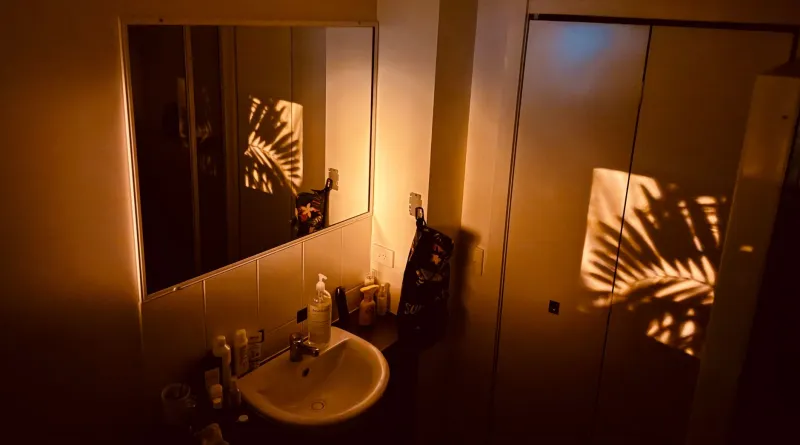
Warm light around 2700K to 3000K feels cozy but can make makeup look different in daylight. Cool light around 4000K to 5000K can feel clinical, and very cool light can make skin look gray or green. Adjustable color temperature is useful, but only if the mirror remembers your setting and dims smoothly at each end. A mirror that jumps from warm to icy blue with no middle ground is not really tunable. It is a novelty.
CRI matters more than most shoppers think
Color rendering index, or CRI, describes how faithfully a light source shows colors compared with daylight. A high CRI helps you see redness, foundation mismatch, and the difference between navy and black. But the average CRI can hide problems. Ask about R9, which measures red rendering. A light with a strong overall score but weak red output can flatten lips and skin tone. For a bathroom mirror in 2026, I would want CRI 90 or higher and a decent R9 score, not just a big lumen number on the box.
Glare and facial shadows are the real deal-breakers
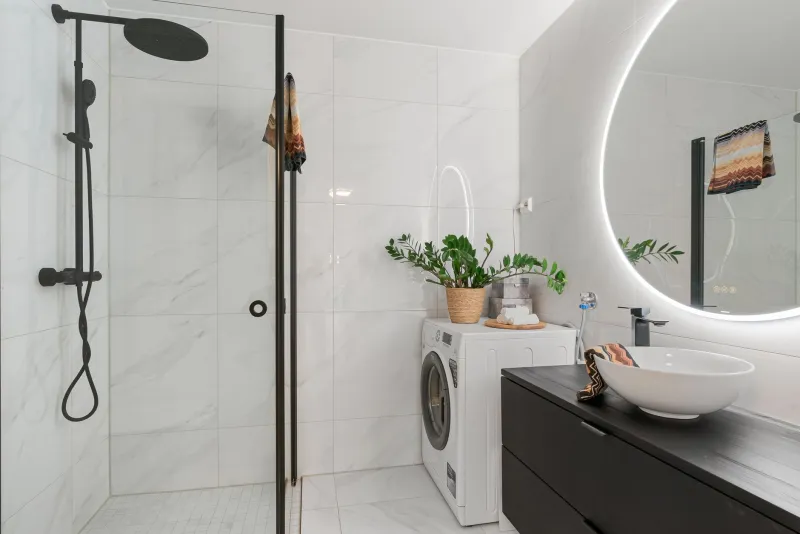
Glare happens when the light source is visible, too intense, or reflected straight into your eyes. It makes you squint, which creates the exact facial tension you do not want before a meeting or a photo. Shadows are the other half of the problem. A single overhead strip can carve dark arcs under the eyes, nose, and chin. A mirror with light only at the top can make a beard line or blush placement hard to judge. The best setups put soft light on both sides of the face at roughly eye level, with enough diffusion that you cannot see individual LEDs.
What this means for grooming and selfies
For grooming, even light matters more than maximum brightness. You want to see texture without harsh contrast, and you want color that does not lie about your skin. For selfies, the mirror becomes a light source and a background at the same time. Cool, narrow light can make a phone photo look sharp but unflattering. Warm, dim light can make it soft but muddy. The sweet spot is a broad, diffused source that is slightly warmer than daylight, positioned in front of the face rather than above it. That is why a ring light on a tripod often beats a fancy mirror for photos: it is all soft frontal light and no mystery.
A simple at-home testing protocol
- Test at night with the bathroom’s other lights off, then repeat with them on. You are checking the mirror as a standalone source and as part of a real room.
- Stand where you actually get ready. Look for glare at eye level, then sit if you use the mirror while seated.
- Hold a white sheet of paper under your chin. If it looks pink, green, or blue, the color temperature is doing something you need to notice.
- Check shadows under your eyes, nose, and jaw. Move the mirror or your stance slightly. If the shadows get worse, the light placement is wrong.
- Use a phone camera in selfie mode with no filter. Take one shot at the lowest dim setting, one at the middle, and one at full. Compare skin tone and shadow depth.
- Look for flicker by viewing the mirror through your phone camera. Bands or pulsing are a red flag, even if your eyes do not notice it.
- Bring a favorite makeup or skincare product into the test. If the color looks different from how it looks near a window, the mirror is not giving you reliable color.
The 2026 checklist beyond raw lumens
- Ask for lux at face height, not just total lumens.
- Look for CRI 90 plus and a published R9 score.
- Confirm adjustable color temperature with a usable warm and cool range.
- Check that dimming goes genuinely low, not just from bright to slightly less bright.
- Look for a diffused panel with no visible LED hotspots.
- Test for flicker with a phone camera.
- Make sure the light comes from both sides of the face, not only overhead.
- Confirm the mirror height matches your eye line and the room’s counter height.
- Buy from a retailer with a real return window. Lighting is personal, and a mirror that flatters one face can make another look washed out.
The smart mirror category has a spec-sheet problem. It is easy to sell a big number and hard to describe the soft, even, color-accurate light that makes a bathroom mirror useful. In 2026, the better question is not how many lumens a mirror claims. It is whether the light lands on your face without glare, without weird color, and without turning your morning routine into a guessing game.